Backend Development: Why It's More Than Just Writing APIs
Most developers start their backend journey the same way—creating endpoints, connecting databases, and making things work. But here's the truth that only comes with experience: backend development is about building systems that handle real users and real problems.
The Real Backend Development Landscape
When Divya Pratap Singh shared his journey of understanding backend development as a complete system, it resonated with countless developers. The reality is that powerful APIs are just the visible tip of a much larger iceberg.
Behind every smooth app experience lies a robust backend infrastructure that manages:
- Efficient request handling that responds in milliseconds
- Clean architecture that scales without breaking
- Database management that keeps data organized and accessible
- Strategic caching that boosts performance
- API security that protects sensitive information
- System reliability that handles traffic spikes gracefully
The 12 Pillars of Backend Excellence
1. Understanding Client Requests
Backend systems receive requests from multiple sources—web applications, mobile apps, third-party services, and testing tools like Postman. Each requires careful consideration of input formats, authentication, and response structures.
2. Mastering the Request Flow
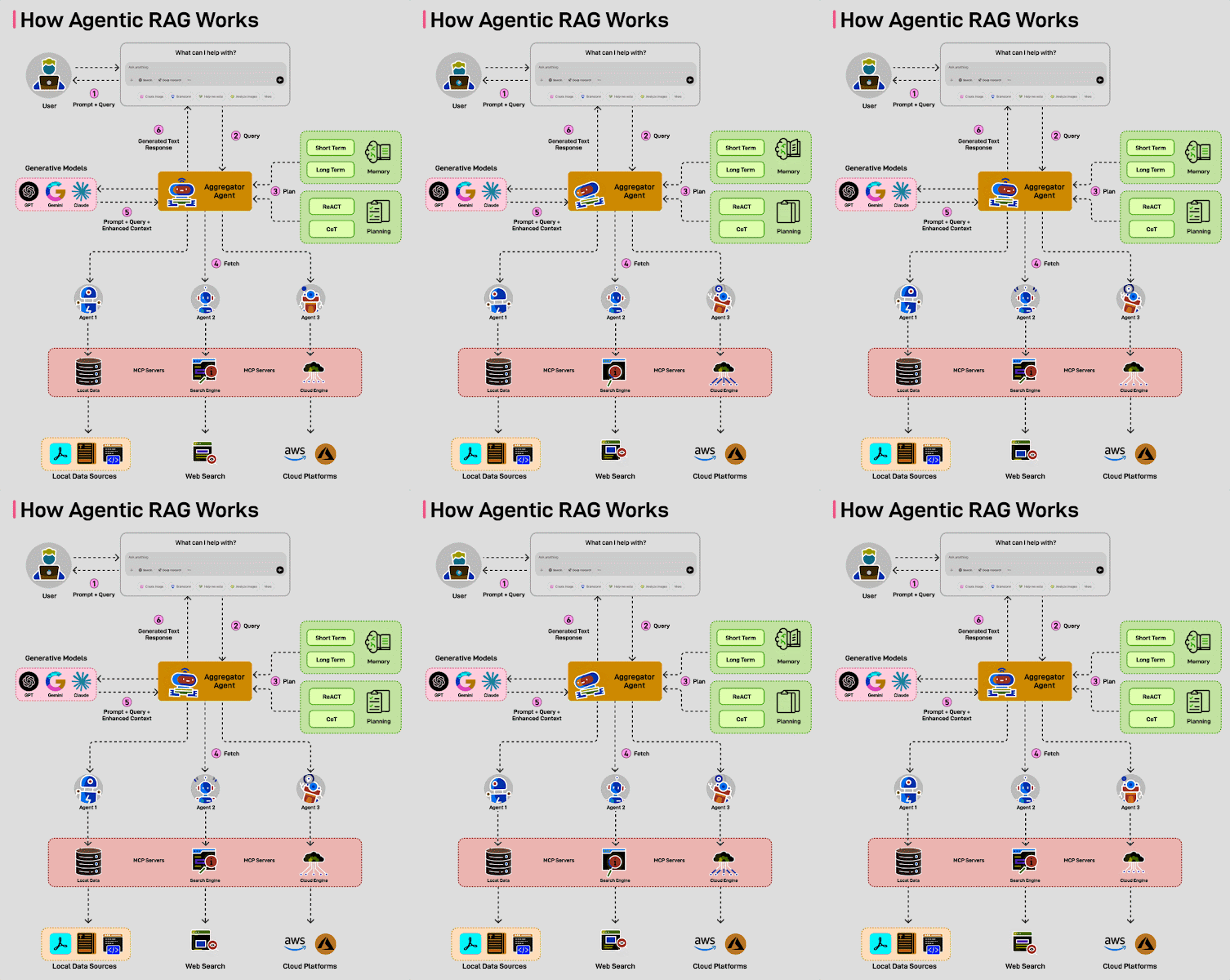
Every request follows a complex journey: DNS lookup → Load Balancer → API Gateway → Application Server. Understanding this flow is crucial for debugging and optimization.
3. Building Core Architectural Layers
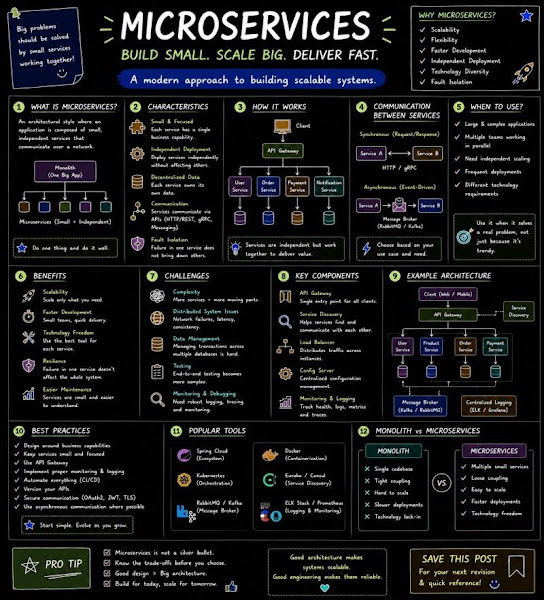
Modern backend architecture follows a layered approach: - Controller Layer: Handles incoming requests and responses - Service Layer: Contains business logic - Repository/DAO Layer: Manages data access - Database: Stores and retrieves persistent data
4. Database Design Excellence
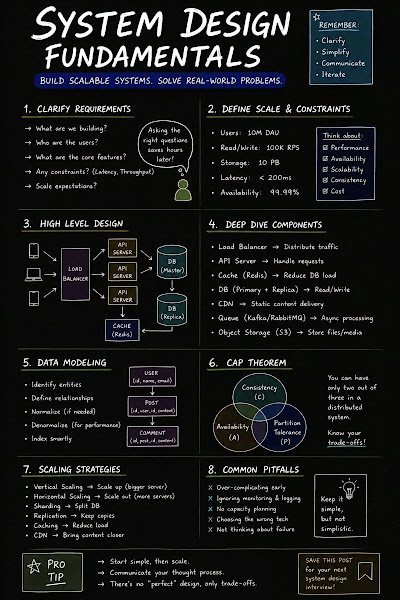
Database design goes beyond simple schema creation. It requires understanding normalization, indexing strategies, denormalization for performance, and choosing between relational, NoSQL, and in-memory databases.
5. Strategic Caching
Caching dramatically improves performance. Master cache-aside, write-through patterns, TTL (Time To Live) settings, and cache invalidation strategies.
6. Security at Every Layer
Robust backend security includes: - Authentication (JWT, OAuth2) - Authorization with roles and permissions - Input validation - HTTPS/TLS encryption - Rate limiting to prevent abuse
7. Graceful Error Handling
Users should never see internal errors. Use meaningful status codes, consistent response formats, comprehensive logging, and never expose sensitive information.
8. Performance Optimization
Speed determines user satisfaction. Optimize through efficient code, proper database indexing, pagination, asynchronous processing, connection pooling, and CDN implementation.
9. Asynchronous Processing
Not every task needs immediate response. Message queues and event-driven architectures handle background processing efficiently.
10. Logging and Monitoring
You can't improve what you don't measure. Implement comprehensive logging, health monitoring, metrics tracking, and intelligent alerting using tools like ELK Stack, Prometheus, or Application Insights.
11. Deployment Excellence
Modern deployment involves CI/CD pipelines, containerization with Docker, orchestration with Kubernetes, and tools like GitHub Actions or Jenkins.
12. Planning for Scalability
Design for growth from the start. Understand horizontal vs. vertical scaling, database scaling through read replicas and sharding, stateless services, and load balancing.
Best Practices That Actually Matter
The most successful backend developers follow timeless principles:
- Keep it simple and clean—complexity is the enemy of reliability
- Follow SOLID principles—they prevent technical debt
- Design for failure—assume things will break and plan accordingly
- Test thoroughly—unit tests, integration tests, and load tests
The Core Truth
Great backend development is not just about writing code. It's about building systems that are reliable, secure, and scalable.
The tools and frameworks will continue to evolve, but the fundamental principles remain constant. Focus on understanding architecture, performance optimization, security fundamentals, and system design.
Conclusion
If you're feeling overwhelmed by backend development, remember: every expert started exactly where you are now. The journey from "controller-service-repository" to understanding complete system architecture takes time, but each concept you master brings you closer to building applications that truly make a difference.
The question isn't whether you can learn backend development—it's how deeply you want to understand the systems that power our digital world. Start with fundamentals, build incrementally, and always keep the end user in mind. That's how reliable systems are born.