The Microservices Reality Check Most Developers Need
Let's be honest: microservices are having a moment. Every tech blog, conference talk, and senior engineer's advice seems to point toward breaking everything into small, independent services. But here's what nobody tells you early in your career—most systems don't need microservices at the start.
This isn't about rejecting modern architecture. It's about understanding when complexity becomes an asset rather than a liability.
What Are Microservices, Actually?
Microservices represent an architectural style where an application constructs itself as a collection of small, autonomous services. Think of it like a city where each neighborhood manages its own infrastructure, communicates through defined channels, and operates independently.
Compare this to a monolithic architecture—one massive application where everything lives together. Need to update the payment module? In a monolith, you're touching the entire codebase. In microservices, that service handles its own deployment, scaling, and maintenance.
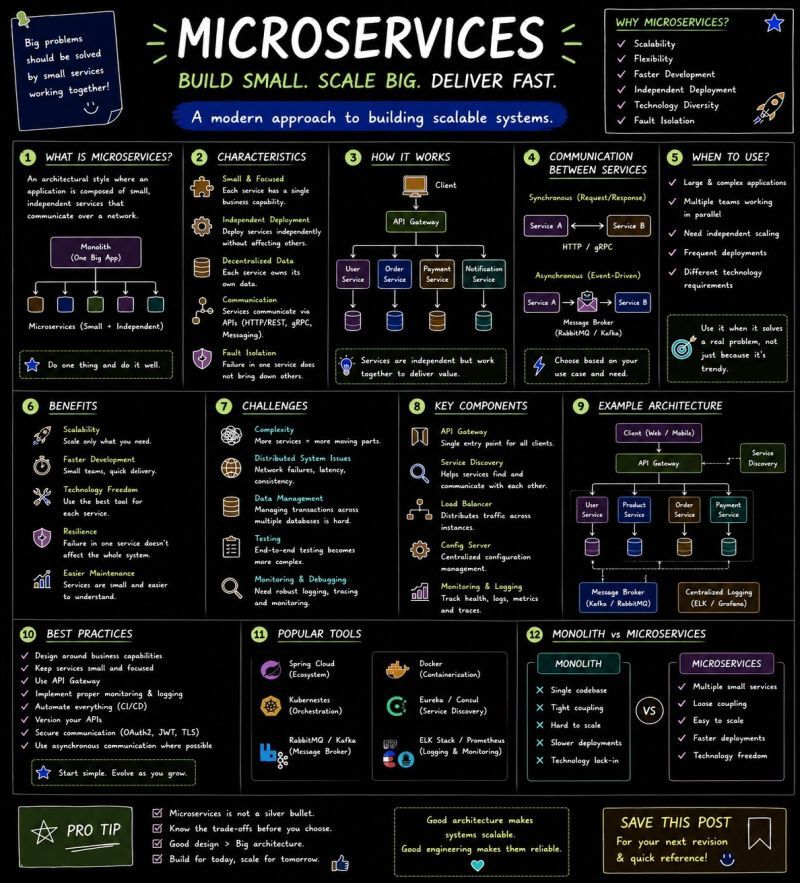
The visual from the featured infographic perfectly captures this: separate, connected boxes versus one large container holding everything.
Core Characteristics That Define Microservices
Understanding microservices means recognizing these fundamental traits:
- Small & Focused: Each service does one thing exceptionally well
- Independent Deployment: Teams release updates without coordinating entire system rollouts
- Decentralized Data: Services own their databases, preventing tight coupling
- Communication via APIs: Services interact through well-defined interfaces, either synchronously (HTTP/gRPC) or asynchronously (message brokers like Kafka or RabbitMQ)
- Fault Isolation: When one service fails, the broader system continues operating
When Microservices Actually Make Sense
Here's where many developers go wrong—they adopt microservices before their system requires them. Consider this your decision-making checklist:
✅ Scale is becoming a bottleneck ✅ Multiple teams need to work simultaneously ✅ Independent deployment flexibility is critical ✅ Different components have vastly different resource needs ✅ Fault isolation directly impacts business continuity
If you're building a startup MVP or a solo project, a well-structured monolith will serve you better. You can always extract services later as scale demands grow.
Benefits That Justify the Switch
When the timing is right, microservices deliver measurable advantages:
| Benefit | Real-World Impact | |--------|------------------| | Scalability | Scale specific services under heavy load without affecting others | | Technology Freedom | Use the best tool for each service's specific requirements | | Faster Development | Smaller teams ship features independently and quickly | | Resilience | System continues functioning when individual services fail | | Easier Maintenance | Developers understand and modify smaller codebases |
The Challenges Nobody Warns You About
Microservices introduce real complexity that your team must manage:
- Network Complexity: Method calls become network requests with latency, failures, and retry logic
- Data Consistency: Maintaining data integrity across distributed databases requires careful design
- Debugging Difficulty: Tracing issues across multiple services demands sophisticated logging and monitoring
- Operational Overhead: Deployment pipelines, service discovery, and configuration management multiply
Tools That Make Microservices Viable
Modern microservices rely on a robust ecosystem:
- Containers: Docker enables consistent service packaging
- Orchestration: Kubernetes handles deployment, scaling, and management
- Service Discovery: Tools like Eureka or Consul help services locate each other
- API Gateways: Central entry points managing authentication, routing, and rate limiting
- Monitoring: Prometheus and ELK Stack provide observability across the system
- Message Brokers: Kafka or RabbitMQ enable asynchronous communication patterns
Making the Right Architectural Choice
Good architecture isn't about choosing the most sophisticated option—it's about selecting the right level of complexity for your current needs.
Start with a monolith when you're validating ideas or building team cohesion. Extract services strategically as concrete requirements demand it.
Remember: Good architecture makes systems scalable. Good engineering makes them reliable.
The microservices path works best when your organization, team size, and scaling requirements genuinely justify the operational investment. Choose wisely, evolve gradually, and always prioritize solving real problems over chasing trends.