Why Systems Break in Production: The Real Art of System Design
Every engineer has seen those perfect architecture diagrams. Load balancers here. Databases there. Caches distributed perfectly. Clean lines. Beautiful boxes.
But here's the uncomfortable truth most of us learn the hard way:
Most systems look perfect on paper and break spectacularly when real traffic hits.
After years of building and scaling systems, I've developed a mental framework that changed everything for me. It's not about finding the perfect architecture—it's about making decisions that survive real-world pressure.
Where Real Design Actually Starts
Early in my career, I thought system design meant drawing architecture diagrams. I focused on selecting the right tools, the latest databases, the trendiest frameworks.
I was completely missing the point.
Real system design starts with asking the right questions before you write a single line of code:
- What scale are we actually dealing with?
- What are our constraints—time, budget, team expertise?
- What happens when individual components fail?
- What trade-offs are we comfortable making?
These questions matter more than any technology choice you'll make.
The Framework That Changed Everything
I created a mental model that structures my entire approach to system design. It moves from broad to specific:
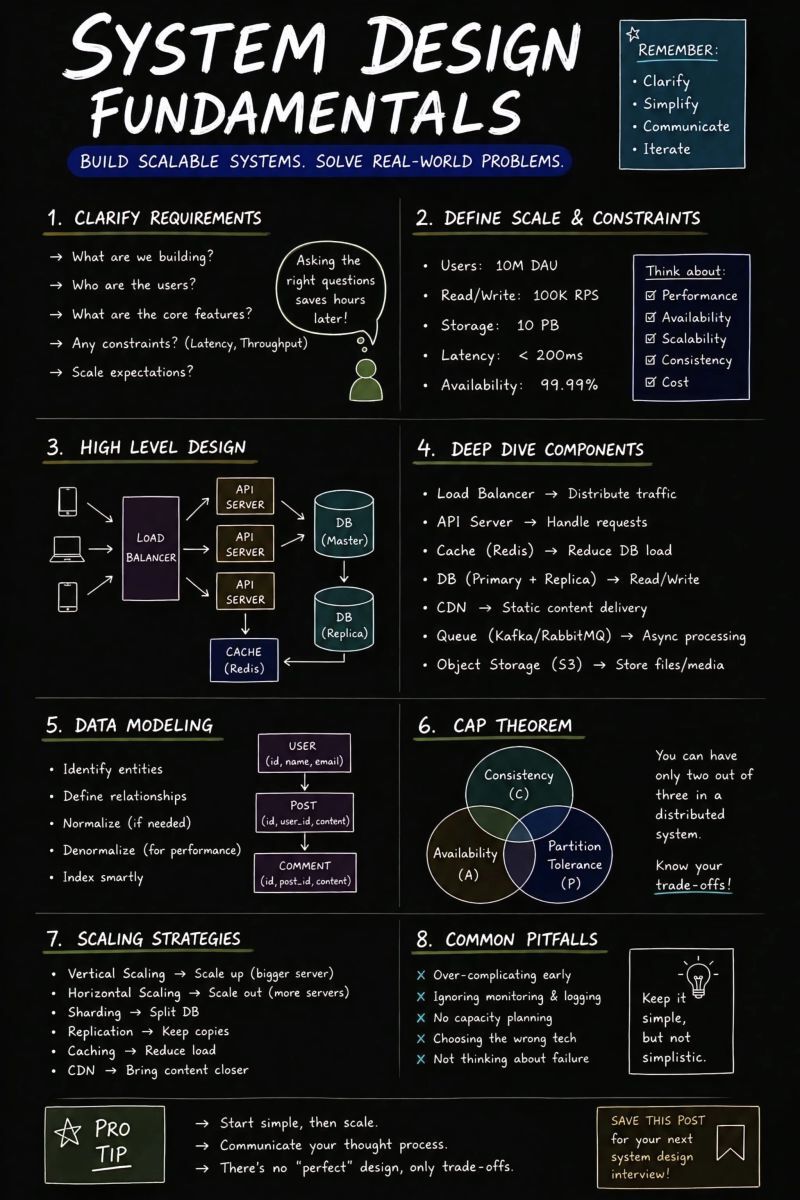
Requirements → High Level Design → Deep Dive Components → Scaling and Reliability
1. Requirements (The Foundation)
Before anything else, understand what you're actually building. Define functional requirements, performance targets, and success metrics. This is where most projects go wrong—they skip this step entirely.
2. High Level Design (The Map)
Create a clear picture of how components interact. Identify potential bottlenecks and plan for failure points before they become problems.
3. Deep Dive Components (The Detail)
Examine individual services, databases, and interfaces. Understand data flow, latency expectations, and dependency chains.
4. Scaling and Reliability (The Survival)
Design for chaos. What happens when your database connection pool exhausts? When your cache fails? When traffic spikes 10x overnight?
Designing for failures, not just success, is what separates resilient systems from elegant diagrams.
The Trade-Offs You Can't Ignore
Every architectural decision involves trade-offs:
- Consistency vs. Availability: Can you sacrifice some consistency for faster responses?
- Complexity vs. Maintainability: That brilliant distributed solution might require a PhD to debug at 3 AM.
- Cost vs. Performance: More resources cost more money. Shocking, I know.
The engineers who build lasting systems understand that there's no perfect solution—only the solution that fits your specific context.
What I've Learned
The more I study system design, the more I realize something counterintuitive: it's not about finding the optimal solution.
It's about making informed decisions that your team, your infrastructure, and your users can actually live with.
The best systems I've seen weren't architecturally perfect. They were pragmatic, well-understood, and designed to handle real-world chaos.
So next time you're reviewing an architecture diagram, ask yourself: "Will this survive production?"
If the answer isn't clear, you might need to go back to the drawing board—before reality does it for you.
Ready to build systems that actually work? Start by questioning your assumptions before questioning your architecture.