Netflix Live Origin is the unsung hero of global live streaming. Operating as a custom-built, quality-control checkpoint, it sits directly between Netflix’s cloud-based live streaming pipelines and Open Connect (Netflix’s colossal Content Delivery Network). Its primary job? Deciding exactly which video segments get delivered to millions of simultaneous viewers worldwide.
When Netflix transitioned from Video on Demand (VOD) to live streaming, they faced a radically different set of engineering hurdles. VOD content is meticulously processed and cached well in advance. Live streaming, however, operates under ruthless time constraints. Every single video segment must be encoded, packaged, and distributed globally within seconds.
Here is a deep dive into the architecture of the Live Origin system and the clever engineering decisions Netflix made to guarantee real-time reliability at a massive scale.
The Core Architecture: How It Works
Operating as a multi-tenant microservice on Amazon EC2 instances, the Live Origin relies on a surprisingly straightforward communication model:
- Ingest (PUT): The Packager—responsible for preparing video segments—pushes these segments to the Origin using standard HTTP PUT requests.
- Delivery (GET): Open Connect nodes pull these segments for user delivery using HTTP GET requests.
Because the URL used for the PUT request perfectly matches the URL for the GET request, the system establishes a highly efficient, predictable storage and retrieval pattern.
Inside the "Smart Origin" Pipeline
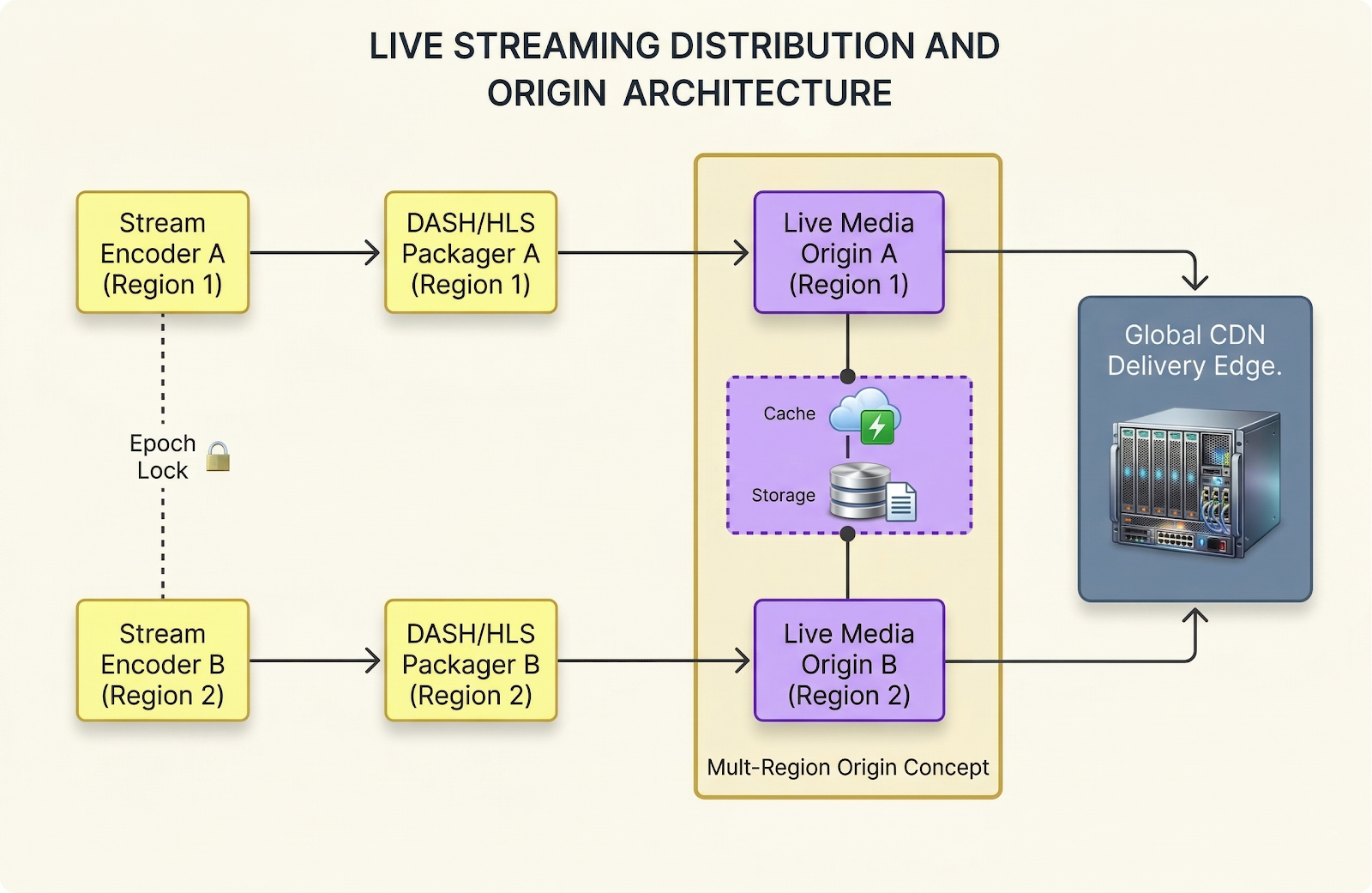
(Insert your diagram here)
As seen in the distribution architecture, the process is highly resilient. Let's break down the flow:
- Cloud Encoders: Raw live feeds are ingested and compressed. Notice the Epoch Lock syncing the two independent encoders to ensure strict timeline consistency.
- Packagers: These nodes format the encoded media into deliverable segments (e.g., 2-second chunks) tailored for specific regions.
- The Smart Origin: This central hub houses the Live Origins for different regions, backed by a robust shared Cache and Storage layer. It acts as the final decision-maker before content hits the CDN.
- Open Connect: Netflix’s CDN infrastructure that actually serves the video to your living room TV or smartphone.
The 2 Pillars of Netflix's Live Architecture
To handle the immense pressure of live global broadcasting, Netflix built the system around two non-negotiable architectural choices:
1. Redundant Regional Pipelines
Instead of risking a single point of failure, Netflix runs two completely independent encoding pipelines simultaneously. Each pipeline lives in a separate cloud region, utilizing its own dedicated encoder, packager, and video contribution feed. If Region 1 experiences a latency spike or hardware failure, Region 2 is already processing the exact same live feed.
2. Predictable Manifest Design
Traditional streaming often requires constantly updating a manifest file to tell the client what segments are available. Netflix opted for a predictable template with a constant segment duration of exactly 2 seconds. By doing this, the Live Origin doesn't need to wait for manifest updates; it can mathematically predict exactly when the next segment should arrive and be published.
Multi-Pipeline Awareness and "Intelligent Selection"
Live video is inherently messy. Unpredictable feeds and strict real-time deadlines inevitably lead to defects—missing audio samples, dropped video frames, or incorrect decode timestamps.
Because Netflix runs two independent pipelines, the mathematical probability of both pipelines producing a defective segment at the exact same millisecond is incredibly low.
This is where the Live Origin earns its "Smart" title. When Open Connect requests a segment, the Origin evaluates candidates from both pipelines in a predetermined order.
- The Packager performs lightweight media inspections on the fly.
- It attaches defect information as metadata when publishing to the Origin.
- The Origin reads this metadata, discards the flawed segment, and instantly serves the valid segment from the secondary pipeline.
In the extraordinarily rare event that both segments are corrupt, the Origin passes this defect metadata downstream so the client application can handle the error gracefully without crashing the stream.